Three Layers. Total Protection.

Proof

We publish only what we can source

Below is the evidence behind Shield3, drawn from independent laboratories, the manufacturer's testing program, and our own field measurement. Each result is shown with its source and reported on its own terms — laboratory efficacy and field bioburden are never merged.

Shield3's Layer 1 surface product (System 3 SDP) is the non-leaching silane quat chemistry manufactured by 2V Industries. The third-party testing below was conducted on that chemistry; Shield3 private-labels it.

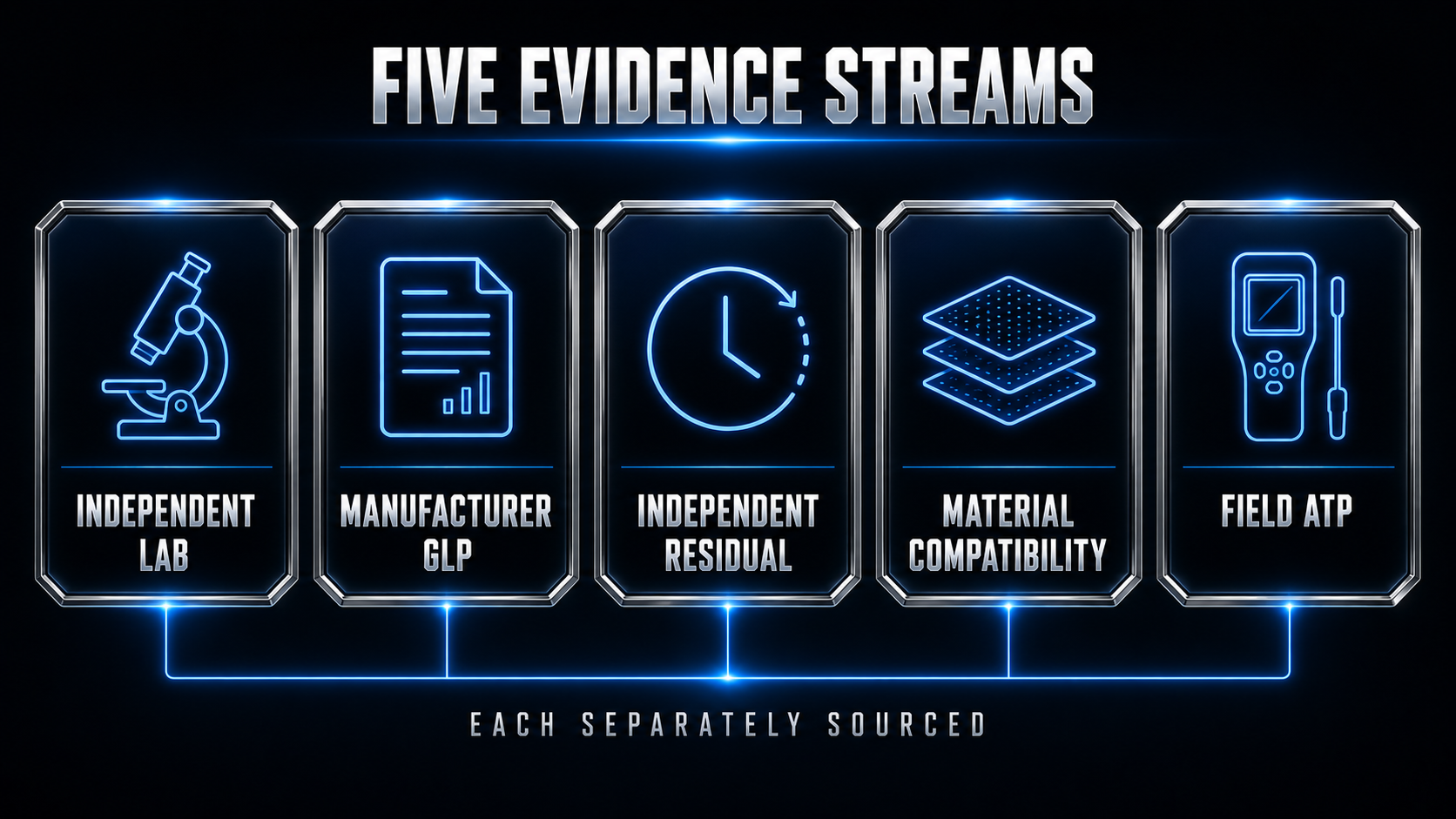
5 evidence streams · each separately sourced

Independent lab–confirmed · Eagle Science-Based Solutions

Laboratory testing

Eagle Science-Based Solutions ran two complementary studies on the System 3 SDP chemistry in 2022: an efficacy study measuring reduction across a broad organism panel, and a dispersion study measuring how evenly the chemistry distributes when applied. Both are independently lab-confirmed.

Independently lab-confirmed

Efficacy panel — Protocol PR-21047

The chemistry was evaluated against a 10-organism panel on three surface types — stainless steel, plexiglass, and vinyl — at a 10-minute dwell, under a protocol harmonizing EN 17272 and USP<1072>. Every organism on every surface met the study's acceptance criteria. Lab conclusion: the chemistry exhibits bactericidal, fungicidal, and sporicidal activity when used as directed.

MeasureResult
Organism panel10 organisms (incl. Staphylococcus aureus / MRSA)
Surfaces testedStainless steel · plexiglass · vinyl
Dwell time10 minutes
Log reduction range4.5 to >6.0 across all organisms/surfaces
OutcomeAll met acceptance criteria

Source · Eagle Science-Based Solutions · Protocol PR-21047 · 2022

Independently lab-confirmed

Dispersion & distribution — Protocol PR-21049

A dispersion study under EN 17272 measured how evenly the chemistry reaches a surface when applied. Against Staphylococcus aureus (ATCC 6538) on stainless steel at a 10-minute dwell, it achieved a ≥5-log reduction at every test zone, meeting the protocol's acceptance criteria.

ZoneLog reduction
Zone 15.7
Zone 2>6.0
Zone 3>6.0
Zone 45.7
Challenge level7.3 × 10⁶ CFU / coupon

Source · Eagle Science-Based Solutions · Protocol PR-21049 · testing 03/14/2022 · approved 03/25/2022

Reporting note: these are CFU-based microbiological challenge tests (not ATP), so log-reduction figures against named organisms are reported as the laboratory measured them.

Attributed · 2V Industries

Manufacturer GLP testing

GLP testing commissioned by the manufacturer evaluated System 3 SDP for bactericidal and virucidal efficacy at a 10-minute dwell, including activity against a coronavirus — reported as a 99.9% reduction in under three minutes.

Source · 2V Industries GLP testing · March 2021. Presented as an attributed third-party finding. Regulated marketing terms used in the manufacturer's own collateral (e.g., "hospital grade," "eradicates") are deliberately not carried onto this page.

Independent residual study

Residual bioburden over time

An independent residual study tracked surface bioburden by ATP (RLU) measurement over a three-week window under continuous heavy-touch conditions — surfaces in daily multi-user contact, with no re-cleaning during the study — using a Hygiena SystemSURE Plus ATP system.

Source · independent residual (Purifly) ATP study. Presented as a bioburden measurement and a description of the study design — not as a fixed "protects for three weeks" duration-of-cleanliness claim.

Boeing multi-surface compatibility testing

Material compatibility

Boeing multi-surface compatibility testing assessed System 3 SDP across a range of materials and found it compatible with electronics, plastics, metals, and fabrics — directly relevant to mixed athletic environments and shared gear.

Source · Boeing multi-surface compatibility testing. Reported as material compatibility (safe on materials), not as antimicrobial efficacy.

Our own measurement · Shield3

Field ATP readings

In March 2026, Shield3 took field ATP (RLU) readings on athletic gear (porous-foam knee and elbow pads), measuring surface bioburden before and after a single application under real conditions — one liberal spray, a 10-minute dwell, and overnight air-dry, with no wipe or rinse. ATP measures biological residue (in RLU) — a measure of cleanliness, not a pathogen-specific kill claim.

ZoneBaseline RLUAfter applicationBioburden change
Knee — outside (front)4,8462,21654.3%
Knee — inside (front)6,34054991.3%
Knee — inside (back)2,97691869.2%
Elbow — outside (funny-bone)1,33464251.9%
Elbow — outside (inner)4,7652,79041.4%
Elbow — inner (funny-bone)6,7381,57476.6%
Elbow — inner (inner)2,18219990.9%

Average single-application reduction in measured surface bioburden: knee pad ~71.6%, elbow pad ~65.2%, with the largest reductions in the interior porous-foam zones.

Source · Shield3 field ATP readings · March 2026 · Hygiena enSURE Touch + UltraSnap. These are reductions in measured surface bioburden (RLU) under real conditions — not a pathogen-specific kill claim and not a duration-of-cleanliness claim. Field measurement is kept separate from the laboratory data above.

How we handle evidence

How we report this

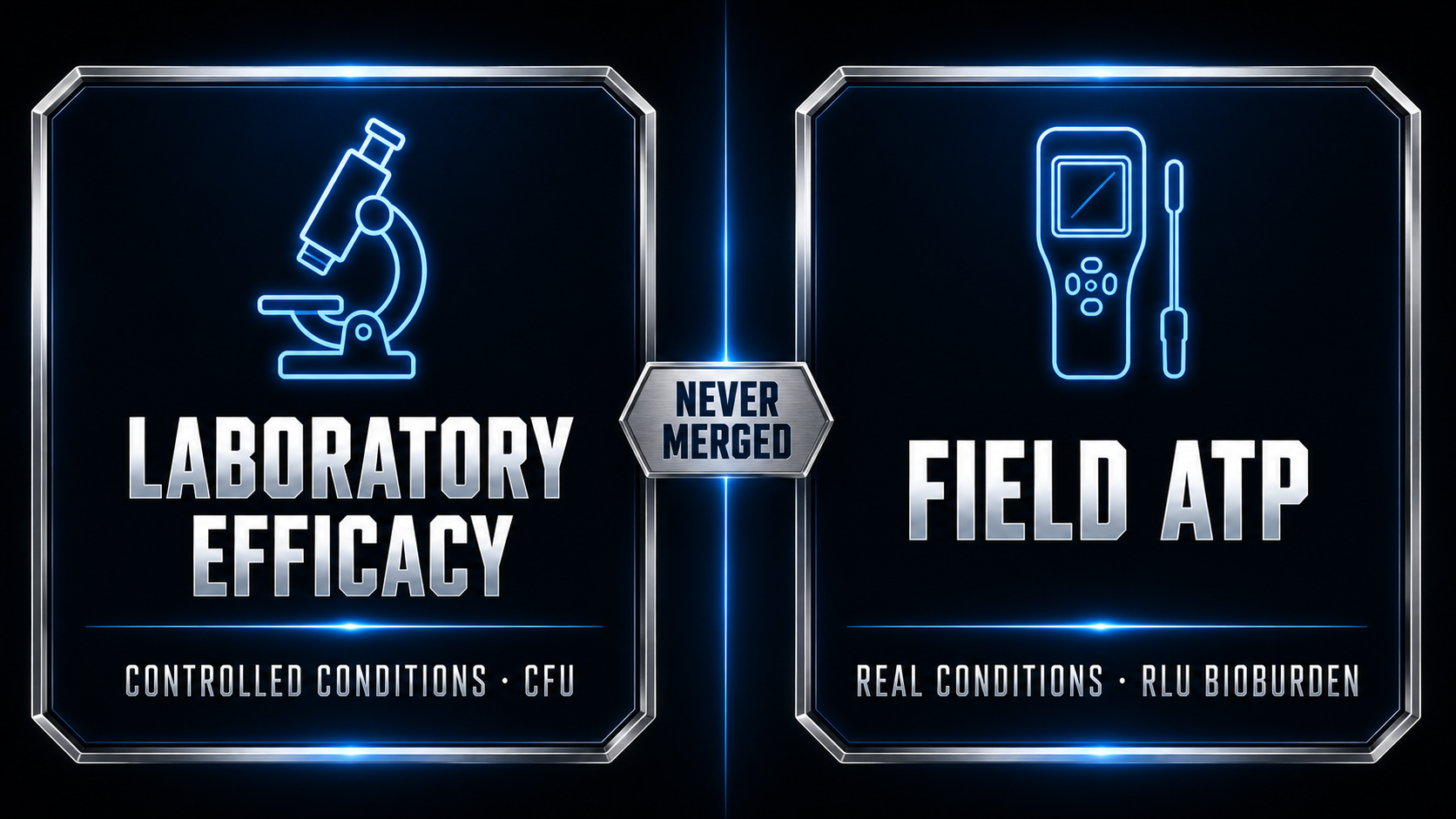
Laboratory efficacy and field ATP measure different things, in different settings. We present each on its own terms and never merge them. Third-party results are attributed to their source; our own field readings are labeled as ours.

Our claims standard

Efficacy data is presented as independent laboratory–confirmed. EPA registration is in progress with the manufacturer, and we will update this page as that status advances — we do not currently represent our products as EPA registered. We describe Shield3 as a persistent barrier layer that complements — does not replace — routine cleaning, we do not claim a fixed duration of protection, and we do not describe treated surfaces as "sterile."

Case Studies

Built from real data, as it comes in

Our case studies are produced from actual treatment data using a fixed reporting template. We don't invent results to fill the page — studies appear here once the data behind them is complete.

In production

Wrestling program

Mat and gear high-touch zones. Before/after field ATP under our standard protocol.

Pending data

Training facility

Full-facility surface and storage-air treatment.

Pending data

Locker / weight room

High-touch surfaces and shared equipment.